If I could name one thing that I have always dreamed of being my full-time job, I would definitely say “Travelling!”
Imagine how exciting it could be to travel the world, exploring place to place, meeting new faces and experiencing things you’ve never done before! It’s always been thrilling—either the adventure or… the fact that I have to deal with my motion sickness.
I always wonder how my deaf friends could survive the climb of a mountain trail, the twists and turns, it already makes my head spin just to think about. Or a sailing trip! I’ve been dying to see the view beyond the passenger deck, but the queasy swell always hits me as soon as I try to get up. And my deaf friends? They’ve had a blast exploring the whole ship already!
At first, I felt like it was just a small, almost trivial difference.
But I started questioning,
What if it wasn’t?
What if this very thing—this motion sickness, actually can unlock the opportunities to travel even further?
Much bigger and wilder places to explore, like… outer space, even?
But further as I questioned, it turns out to be more than just my personal curiosity. I found out that decades ago, it became a scientific puzzle that even NASA was desperate to understand.
So, going back to the late 1950s NASA and the U.S. Naval School of Aviation Medicine launched a collaboration by inviting 11 deaf men to join and assist their spaceflight project. This project required deaf men between the ages of 25-48 to help NASA understand the effects of weightlessness on the human body. Those 11 known as “The Gallaudet Eleven”, consisting Harold Domich, Robert Greenmun, Barron Gulak, Raymond Harper, Jerald Jordan, Harry Larson, David Myers, Donald Peterson, Raymond Piper, Alvin Steele, John Zakutney as a team from Gallaudet University.
Over the course of a decade, The Gallaudet Eleven helped NASA through various experiments that required the ability to manage the body balance in extreme rotating rooms, endurance in zero gravity and agility after going through a spinning room.
Their deafness helped NASA answer,
“Does astronauts’ nausea pose a significant difficulty to research and spaceflight?”
Usually, nausea is triggered by differences in sensory information received by the brain from the eyes, vestibular (part of the inner ear system), and proprioceptive systems, this confusing the commands delivered through your brain cell, resulting in sickness and dizziness.
This explains a theory called “Sensory Conflict Theory”, proposed by a psychologist James Reason. Which simply says that your brain gets confused when your senses (coming from what you hear and what you see) don’t agree.
In this case, the Gallaudet Eleven were chosen because their vestibular system has been badly damaged and shows no working sign, so that their brains did not receive the conflicting motion signal that usually causes nausea.
 [Donald Peterson prepares for a test in a centrifuge. Photo: Gallaudet University Archives]
 [Gallaudet test subjects in a zero-g flight. Photo: NASA Official Website]
Among the various experiments conducted, the most renowned is the Coriolis Acceleration Platform (CAP). This experiment required The Gallaudet Eleven to stay within a centrifugal chamber rotating at 10 rotations per minute. This room is designed to disorient the body of the participants and test how well they can maintain balance under extreme motion. Greenmun, Harper, Larson, and Myers spent 12 days inside the Coriolis Acceleration Platform (CAP), during which they were presented with several sub-experiments designed to test their endurance. One task involved a rapid-counting light game that causes certain aftereffects. Upon exiting the Coriolis Acceleration Platform, they experienced instances of stumbling and momentary loss of focus while throwing a ball.

[John Zakutney is lowered down into a centrifuge pod. Photo: NASA/U.S. Navy/Personal collection of David Myers]

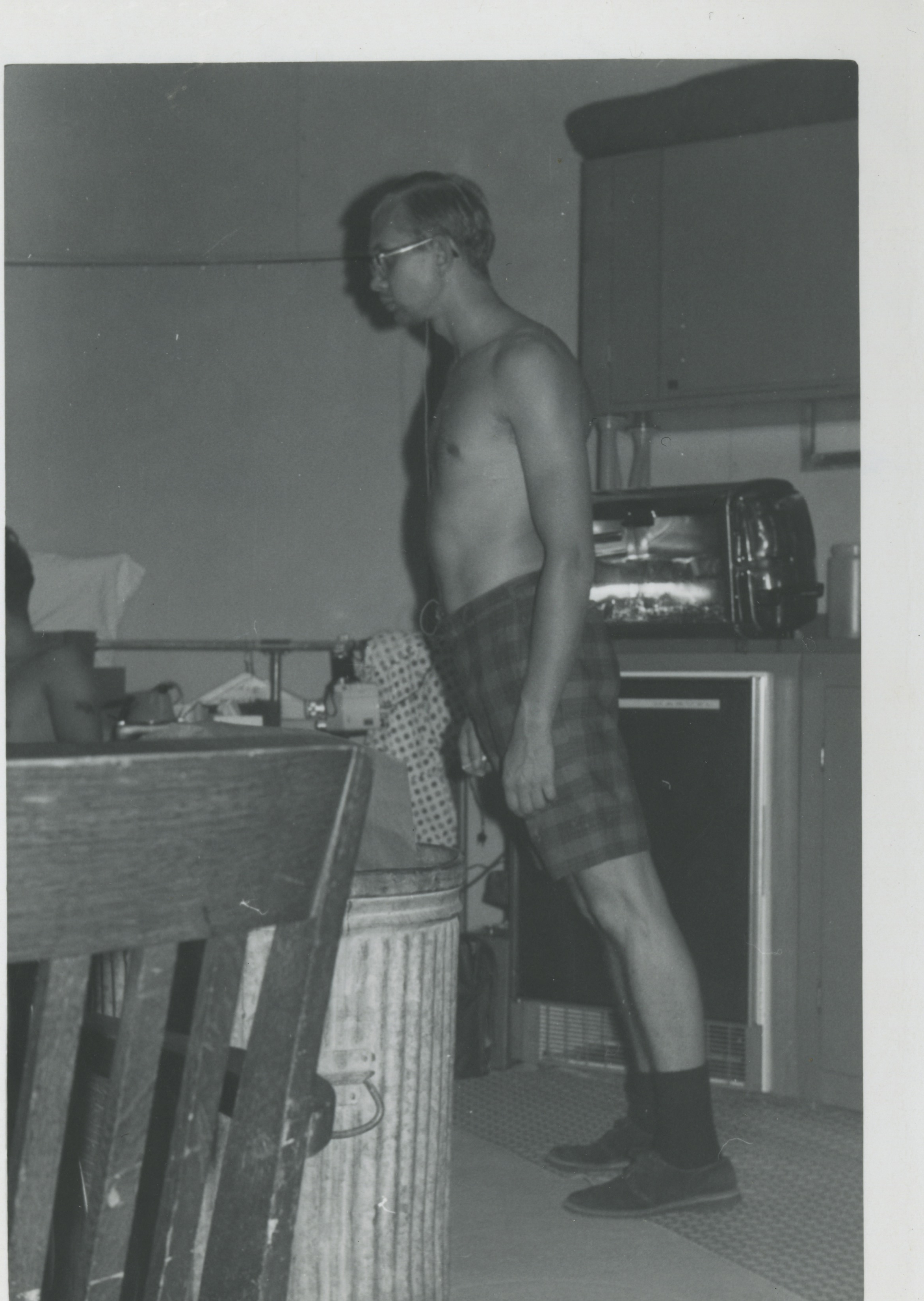
[Harry Larson stands in a 20-foot slow rotation room. Photo: Gallaudet University Archives/Harry Larson collection]
The Gallaudet Eleven team also successfully handled NASA’s “Vomit Comet,” an aircraft designed to simulate zero-gravity conditions, overcoming the nickname created by Project Mercury astronauts during their training session in 1958. The Gallaudet Eleven even managed to not feel nauseous even a bit when they were put into the Empire State Building’s elevator in New York, riding it up and down repeatedly between the first and 80th floors for several hours. They actually made the researchers seasick during the final experiment, a wooden cargo ship called Miquelon which sailed to Nova Scotia, while the Gallaudet Eleven were able to enjoy the trip without even a slightest nausea.
Laboratory test results showed that each participant’s urine did not show any increase in stress hormones, which was in a huge contrast to the hearing participants.
This was a major discovery in the world of spaceflight, aiding researchers in early understanding and designing the Mercury Project missions. It also paved the way for Neil Armstrong’s historic moon landing in July 1969 during the Apollo missions. Moreover, the contributions of the deaf Gallaudet Eleven team also laid the foundation for the successful Artemis II mission in earlymid-2026.
This got me thinking, perhaps all this time, we’ve only focused on things we truly see as obvious—the famous actors, the big discoveries, but we haven’t really delved into the actual process. There are bigger things we can discover if we’re curious enough to dig.
There are things we can truly appreciate more, things that deserve to be celebrated—like the contributions “The Gallaudet Eleven” made to expanding NASA’s understanding of things and building even greater discoveries.
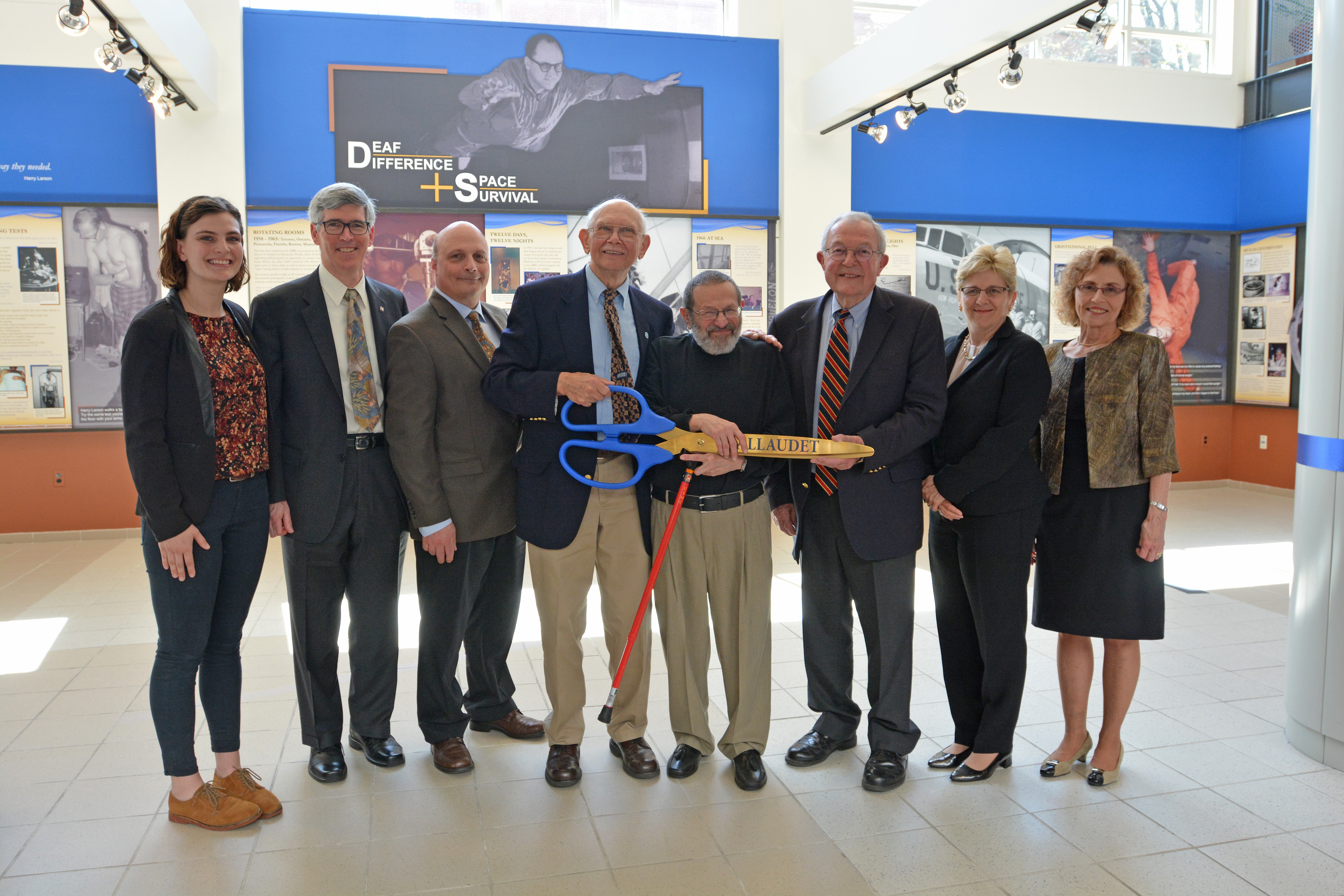
As a form of gratitude, The Gallaudet Eleven was showcased in the “Deaf Difference + Space Survival” exhibition on April 11th, 2017, at the National Museum of Deaf Life at Gallaudet University. Furthermore, in April 2018, NASA extended an invitation to Harry Larson, David Myers, and James Greenmun (son of Robert Greenmun) to visit NASA’s Johnson Space Center for a distinguished presentation and facility tour, expressing appreciation for their contributions to the research in which they participated.
[Ribbon-cutting ceremony for the Gallaudet exhibit. Photo: NASA’s Official Website]
Perhaps, all this time, I’ve been mistakenly seeing motion sickness as nothing but a limitation that holds me back from fully enjoying my trip. However, the story of The Gallaudet Eleven offers a whole mind-refreshing perspective. What it seems like a limitation in one scenario can transform into a significant advantage in another. While most of us struggle against our own standard when the world keeps spinning, they flawlessly move through it with ease. And in doing so, helped humanity take its first steps beyond Earth. It makes me wonder: perhaps the things we lack are not always weaknesses, but untapped forms of strength, waiting for the right moment to matter.
And for the final touch, Harry Larson brought the tour to a heartwarming close with his sincere quote,
“We were different in a way they needed.”
Penulis: Gayuh Tresna Gusti
Sources
Almeida, A. D. (2024, August 28). How 11 Deaf Men Helped Shape NASA’s Human Spaceflight Program – NASA. NASA. https://www.nasa.gov/missions/project-mercury/how-11-deaf-men-helped-shape-nasas-human-spaceflight-program/. Accessed on April 16th, 2026.
Dark Docs. (2020, January 7). Deaf Astronauts – The Gallaudet Eleven [Video]. YouTube. https://www.youtube.com/watch?v=kxAhHKmVjBc. Accessed on April 16th, 2026.
Photos Sources
Picture of Gallaudet test subjects in a zero-G flight. (2021, October 21). NASA. https://www.nasa.gov/image-article/remembering-gallaudet-eleven-their-contributions-spaceflight/. Accessed on April 16th, 2026.
Picture of Harry Larson stands in a 20-foot slow rotation room. (2021, October 21). NASA. https://www.nasa.gov/wp-content/uploads/2017/05/centrifuge.jpeg. Accessed on April 16th, 2026.
Picture of John Zakutney is lowered down into a centrifuge pod. (2020, September 3). Amusing Planet. https://blogger.googleusercontent.com/img/b/R29vZ2xl/AVvXsEjCYPM1SZOh3K79uT8iON_ZPOsWVXFhUahtQtLmU8dnYk95efysEueD9QCMXXPdDvDHgZvDh0Q8jaxSL778V8m4yAbfOQ1iWo0Z1o2U_9fCdMBFle97iuXhr3CZ1diMx7_JdNFV7HgqldY/s0/gallaudet-eleven-2.jpg. Accessed on April 16th, 2026.
Picture of ribbon-cutting ceremony for the Gallaudet exhibit. (2021, October 21). NASA. https://www.nasa.gov/wp-content/uploads/2017/05/kopp_barry_dizio_larson_gulak_myers_cordano_erting1.jpg. Accessed on April 16th, 2026.
Picture of Donald Peterson prepares for a test in a centrifuge. (2021, October 21). Amazing Planet. https://blogger.googleusercontent.com/img/b/R29vZ2xl/AVvXsEgUnL1t7_dY-HhwHhYaIOTEuPwtthEavnnwQgE6SpV8J5JE0AX_I2xppfi7YkowjjKQB3SyDelLsCkO6eXla_rhsEls2q08reoVydCjpeBmZJTg9KaQtV9OfDTwKztGS5DNj-03kGQWVZg/s0/gallaudet-eleven-3.jpg. Accessed on April 16th, 2026.